
Magazine “Mari”, March 2013
Silja Paavle, Õhtuleht
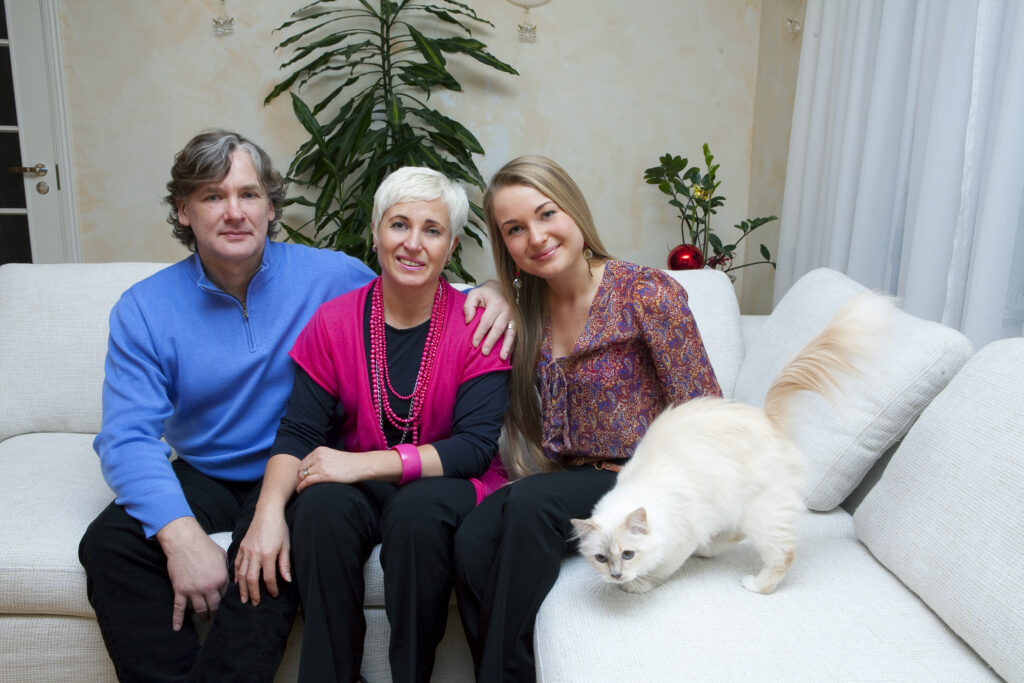
“Did I perhaps live the wrong life and not do what was truly close to my heart?” asks Krista Liiv, who survived a serious brain surgery and has now finally reached a point where she can do what she truly wants.
“Did I really have to live for 45 years and take such a long detour? Apparently, I did. Otherwise, I wouldn’t know how to appreciate my life if I had walked straight to this point,” reflects Krista Liiv (45), a Tallinn resident who spent over ten years leading advertising teams and projects at Eesti Päevaleht and Õhtuleht, and who also founded Ärileht, which is still published today. Recently, she became a massage therapist at a salon operating in the Kristiine district.
Krista has gone through life with the principle that there are no unsolvable situations — only poor problem-solvers. And when someone complains that they don’t know what to do with their life or that something is impossible, Krista responds firmly: “Stop whining, just do it!”
When her house burned down in 2002, in the middle of her career and university exams, there was no talk of “what now.” Krista organized the rebuilding of her home and designed the interior herself. True to her character, it became a cheerfully colorful home, with orange as one of the dominant colors.
When she later felt that all her income was going to the bank, Krista thought for a moment and built a studio apartment above her garage. It became accommodation for tourists who didn’t want to stay in city center hotels. In one summer, the bank loan was paid off, significantly easing her financial burden. Today, the apartment is home to Krista’s daughter, Kristina-Kai (23).
Krista didn’t hesitate long when she decided to give up her career in money and business after a serious brain surgery. “I felt that it wasn’t right and that what I was doing wasn’t close to my heart. Money hasn’t disappeared from the world — it just needs to be found,” she says.
Fighting a brain tumor simply clarified her worldview and helped her understand what truly matters in life. Although it’s an experience she wouldn’t wish even on her worst enemy.
She recalls that everything started to unravel gradually in 2004, when she suffered from severe headaches. “Everything pointed to classic migraine — when I was in darkness and silence, it passed. Sometimes I vomited. I was unable to work for a couple of days,” she describes. She took medication, but doctors didn’t investigate further.
In 2007, while cycling at the gym, Krista heard an enormous noise in her ears, as if something had exploded. The ringing stayed permanently. A substitute family doctor told her that she didn’t have hearing loss and that it wouldn’t kill her.
So Krista lived for several years with constant throbbing and ringing in her ear, feeling that she could barely hear. In 2009, she finally decided to see an ear specialist. When the receptionist discovered that an appointment had just become available, Krista waited an hour outside the doctor’s office.
When she finally entered, Dr. Imbi Markna clasped her hands together and exclaimed: “Dear woman, you are deaf in one ear!” To understand what was disturbing the auditory nerve, Krista was referred to a neurologist.
At the same time, the doctor asked questions that made Krista realize that signs of the tumor had existed for a long time.
For example, balance problems. When moving in the dark, she tended to sway. When skiing, she consistently fell — even on perfectly maintained trails — always to the right. “I blamed it on skis that were too fast,” she jokes.
She also has photos from as far back as 1996 where she subconsciously holds the left side of her head, and where one side of her face appears slightly “sunken.” Only in hindsight does she understand this. Not to mention that her cosmetician had often noted that one eyebrow was lower than the other.
A CT scan finally revealed the truth. Five days before Christmas Eve, the doctor told Krista that she had a brain tumor. “Uh-huh,” she replied, as the news didn’t really sink in. “Like a flower child,” she laughs now.
The doctor continued mercilessly, explaining that the tumor was about the size of a hen’s egg and should be removed, even though it was difficult to get appointments with neurosurgeons.
Krista had a habit of visiting her family doctor after seeing specialists to keep them informed. It was only when she left her family doctor’s office that the reality finally hit her. The rest of the day passed in a haze.
She immediately called her husband Aivar (49) to share the bad news. He was understandably speechless, but confident enough not to allow Krista to stay home alone and took her along to his activities. This was a good thing, because when Krista was briefly alone a few days later, she was overwhelmed by despair. “I didn’t know whether I had three days, three months, or three years left to live,” she sighs.
When she tried to book an appointment with a neurosurgeon, she was offered one at the end of March. “But what do you have otherwise?” asked the receptionist, taking Krista’s referral. “Oh my God, you have a brain tumor!” she exclaimed, causing Krista to burst into tears.
The receptionist took a risk and called the doctor directly. And, once again, a surprise — the next appointment had just opened up. Krista was seen immediately. “At moments like that, I felt that everything was somehow already arranged. That when things are meant to flow, they do,” Krista says.
The neurosurgeon managed to calm her by explaining that the tumor was benign and describing the surgery, which would leave a 6–7 cm incision in her head. “He calmed me so much that it felt as if the tumor was already gone. He only forbade me from running or falling,” she recalls.
Before the surgery in early March, Krista could only think about her hair and how it would look afterward. At work, she said she would be away for a couple of weeks and then return. She didn’t want to worry her colleagues and tried to remain as optimistic as possible.
In reality, she couldn’t have imagined what awaited her even in her worst nightmare. After the 5.5-hour surgery came horror — vomiting, unbearable pain, and an inability to understand exactly where it hurt. Everything hurt, even her toenails. “No one knew how long it would be this bad,” she says. Doctors could only say they had done their best and that the surgery had been difficult. The tumor’s location was so problematic that within three months she would have been partially paralyzed.
“I am incredibly grateful to Dr. Mihkel Leiner and Dr. Kahro Tall — what they did was a miracle.”
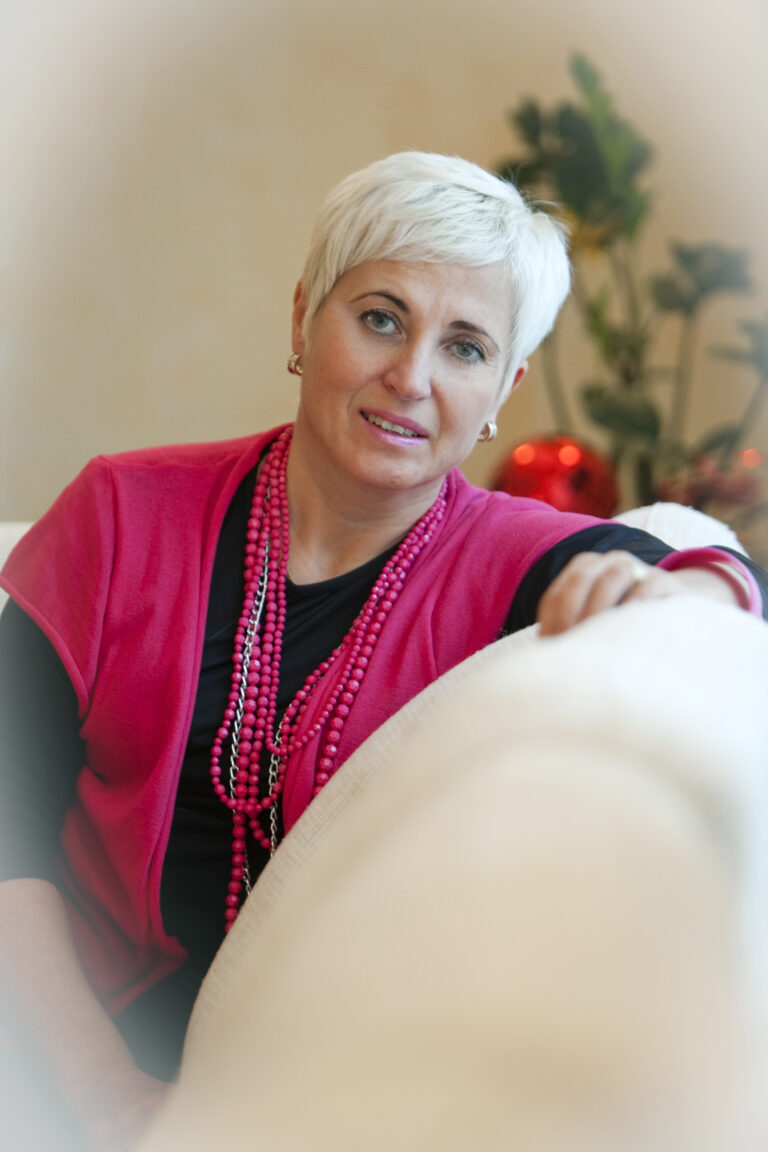
After days without food and overwhelming weakness, on the fourth day Krista decided she would get up — now or never. “I had been told that I would one day live by a warm sea. I thought I couldn’t die before I had lived there,” she laughs. With trembling hands, she forced herself to eat a banana. “Oh, it tasted awful!” The nurse immediately called the team: “She started eating!”
The first look in the mirror was the most unbelievable moment of her life. “The left side of my face had no wrinkles at all — completely smooth!” she marvels. This was caused by facial paralysis. Krista wasn’t prepared for that. At first, she slept without knowing that one eye remained open, causing dryness and pain that persists to this day. She also became deaf in her left ear.
She later discovered that the promised 6 cm incision had become 15 cm. The tumor was identified as an auditory nerve tumor, usually affecting elderly people.
Krista spent a couple of weeks in hospital and was on sick leave for six months.
“She’s a tough woman — she’ll manage!” doctors told her loved ones already in the first days after surgery. And Krista was tough. She didn’t lose her joy of life even in the hospital. “I had so much to do there! I helped others, observed people, listened to my roommates’ worries,” she recalls.
Recovery after discharge was more difficult due to a weak rehabilitation system. But Krista doesn’t give up. With a partially paralyzed face and limited use of her left arm, she pushed forward.
Having completed various massage courses after university, she was able to help herself. In hindsight, she sees those courses as preparation for her future life.
After becoming unemployed, Krista went straight to the Unemployment Insurance Fund and asked for additional massage training. She greatly enjoyed her year of studies and unemployment. “Last summer, I spent 32 days by the sea! I couldn’t have done that while working,” she says happily. She worked as a secretary for sailing competitions — a role she has held for 20 years.
When people ask her sympathetically how she manages while unemployed, Krista responds with sparkling eyes: “Just fine. You don’t need much to keep your soul alive. And if I’m not working, all work-related expenses disappear too,” she laughs.
Eventually, her active spirit couldn’t stay home for long. With support from the Unemployment Insurance Fund, family, and friends, Krista opened her own massage salon. After a few weeks of work, she says: “I feel very good right now. When I massage, I’m in my element. Everything disappears — bad weather, worries — everything.”
Krista’s skilled hands and thoroughness have earned her a strong reputation, and clients seem to find her naturally. Her working motto comes from her teacher Lauri Rannama: “If there’s a stone in your shoe, you have to take it out. If you only give painkillers, the stone keeps rubbing.”
The most important lesson Krista wants to share is that no one should be left alone. When she speaks about her family’s support, tears fill her eyes. “See, I even cry with one eye!” she jokes. She’s also grateful to her friends and sailing community who encouraged her to leave the house after surgery.
“I didn’t want to go. My face was paralyzed, and I wondered how I would communicate. But no one paid attention to my condition — everyone treated me like a normal person!” she says happily.
And despite everything she’s been through, Krista confirms:
“I am alive and healthy, my arms and legs work, and in my opinion, so does my mind — what more could one want from life?”